For a significant portion of the people 2012 has begun on the sour side, with the terrible feeling of being bloated like a red lion fish because of the obligatory end of year orgies of gluttony which they have taken part in lately and which would make any Medieval banquet look pale in comparison, with a hypish January detox to rejuvenate their agonizing liver as well as to illusionally loose all the weight they have accumulated during the festivities and with a drastically tight budget or a bank account in the red as they have irresponsably satiated their appetite for consumerism by living way over their means...
In my case, it has started on a positive note. No need to take desperate decisions to rectify bad past actions or repare what has been annihilated by careless bingeing and money spending. I have continued to lead a healthy lifestyle and to keep my feet on the ground for, in my opinion, excess is quite pointless and makes us even more miserable once the deed has been perpetuated.
“What, then, is the true Gospel of consistency? Change. Who is the really consistent man? The man who changes. Since change is the law of his being, he cannot be consistent if he stick in a rut.”- Mark Twain
Even if I am a dreamer by nature, I perpetually make sure to be grounded, not to lose touch with reality and to be conscious of my limits. I am not against changes, foolishness or risk taking in homeophathic dosage provided that they are free of consequences, ugly repercussions and nasty surprises. Hence, meaningless resolutions, getting back on track and frenzied dieting are not for me. Equilibrium is my middle name and this is the reason why I am capable of keeping my head out of the water even in difficult periods when the line between comfort and precariousness is incredibly thin or blurry and that a little nothing can plunge you into danger.
I have had to go through so many storms for the last 8 years, to sail my boat during multiple tempests and have survived them thanks to my determination, clarity of thought and quest for harmony, so I really don't want to destroy my hardly-earned semi-stability and security. Consistency rules my life, yet in a progressive and non rigid way.
You see, sometimes I love pigging out, but I don't do that on a daily basis. For example, during the week, my meals are very hearty, light, modest and meatless. I sustain myself on kilos of cereals, pulses and vegetables. Then, when the weekend arrives I cook and eat all the fatty, rich and "expensive" ingredients that never make it to my table from Monday morning to Friday lunch time. Cheese, cream, butter, bread, wine, meat and fish reappear on my plate. Shamelessly and with the biggest of pleasures, I allow myself to splurge on those goods as my body as well as soul need them and only quality produces are allowed in my house.
In this manner, debt, crazy fasting and yo-yo effects are words which don't exist in my vocabulary, so once the holidays are over, I don't need to adopt a different attitude in order to heal the wounds of my irresponsability. I mean, how can one have fun and enjoy something when your stomach and system are crying for help, you are throwing precious cash out of the window and you know that afterward you'll have to pay for the broken pots?!
My fridge is perpetually filled with an assortment of seasonal greens which represent the base of my alimentation. Actually, most of the dishes I prepare are composed of at least two or three legumes. I really want to have choice and be able to improvise original meals without problem or having to run out to buy what's missing. Variety is very important. For example, during the winter, I generally stock up on fresh and regional produces such as carrots, potatoes, white cabbage, white radish, fennel, Brussel sprouts, root celery, leek, beets, pumpkin, cauliflower, kohlrabi, etc... As you can see, this wonderful selection enables me not to plan my dinners in advance or be limited and give me enough scope for using my imagination as well as creativity.

Last week, P. came back home with three mammoth white radishes. He had come across them while buying our weekly groceries at the supermarket and was convinced that they might interest me. How thoughtful of him. Of course, thousands of ideas immediately flowed through my head. One in particular captivated my attention: I could put together some "Kimchi". After all, Koreans make that condiment with daikon, so why shouldn't I try developping my own version?
"Kimchi" is not only employed as a relish. In point of fact, it is also a main component of certain popular courses such as soups, stews and fried-rices. Since the prime spice that is employed in its fabrication is red chilli, a New World vegetable that was introduced to Korea from Japan after the Japanese Invasions (1592-1598), the ancestral form of "Kimchi" was exclusively concocted with cabbage and beef stock. It is only during the 12th century that other seasonings were included in the preparation, thus adding sweet and sour flavors and white and orange colors to that delicacy. This is how we know it nowadays.
~ Daikon Kimchi ~
Over the years, I have learnt to become careful and not to gamble with my physical and psychological wellness or to mess with pecuniary matters and not tempt the devil in any way as he never grants long leases and on top of that the uncanny bastard always wants his cash back, with interest."You've been flying so high you don't know- Lyrics taken from Johnny Cash's song "Devil To Pay"
That you're blind to the writin' on the wall
But some day you'll look down
And you'll find you've got no place to fall
When the bright lights're gone you'll be standing alone
Forsaken in the naked light of day
Then you'll know that it's all over but the dying
And you've still got the devil to pay [...]"
I have had to go through so many storms for the last 8 years, to sail my boat during multiple tempests and have survived them thanks to my determination, clarity of thought and quest for harmony, so I really don't want to destroy my hardly-earned semi-stability and security. Consistency rules my life, yet in a progressive and non rigid way.
"All work and no play makes Jack a dull boy,But don't be fooled by my seemingly angelic existence. Be reassured, I am far from being flawless. Like all of you, a small sprinkle of sin doesn't represent a menace to me as long as it is not out of control. Our existence would be boring without transgression, but I also believe that too much of a good thing is not a good thing either. There are borders not to surpass and the same applies to holiness. You have to strike a balance between virtuousness and vice, and be wise, otherwise both behavior patterns become extremely deletarious and can lead us to our ruin.
All play and no work makes Jack a mere toy."
- Maria Edgeworth, Harry and Lucy Concluded
You see, sometimes I love pigging out, but I don't do that on a daily basis. For example, during the week, my meals are very hearty, light, modest and meatless. I sustain myself on kilos of cereals, pulses and vegetables. Then, when the weekend arrives I cook and eat all the fatty, rich and "expensive" ingredients that never make it to my table from Monday morning to Friday lunch time. Cheese, cream, butter, bread, wine, meat and fish reappear on my plate. Shamelessly and with the biggest of pleasures, I allow myself to splurge on those goods as my body as well as soul need them and only quality produces are allowed in my house.
In this manner, debt, crazy fasting and yo-yo effects are words which don't exist in my vocabulary, so once the holidays are over, I don't need to adopt a different attitude in order to heal the wounds of my irresponsability. I mean, how can one have fun and enjoy something when your stomach and system are crying for help, you are throwing precious cash out of the window and you know that afterward you'll have to pay for the broken pots?!
My fridge is perpetually filled with an assortment of seasonal greens which represent the base of my alimentation. Actually, most of the dishes I prepare are composed of at least two or three legumes. I really want to have choice and be able to improvise original meals without problem or having to run out to buy what's missing. Variety is very important. For example, during the winter, I generally stock up on fresh and regional produces such as carrots, potatoes, white cabbage, white radish, fennel, Brussel sprouts, root celery, leek, beets, pumpkin, cauliflower, kohlrabi, etc... As you can see, this wonderful selection enables me not to plan my dinners in advance or be limited and give me enough scope for using my imagination as well as creativity.
Last week, P. came back home with three mammoth white radishes. He had come across them while buying our weekly groceries at the supermarket and was convinced that they might interest me. How thoughtful of him. Of course, thousands of ideas immediately flowed through my head. One in particular captivated my attention: I could put together some "Kimchi". After all, Koreans make that condiment with daikon, so why shouldn't I try developping my own version?
A few seconds later, I was surfing the net in search of tips and technical advice. Once I had gathered all the information I needed, I rushed straight to my kitchen and got crackling. Being a "pro" when it comes to inventing formulas, I wrote down my recipe as I went along.
This banchan (side dish) is a kind of lacto-fermented pickle that comes from Korea and matures in big earthenware jars. The earliest reference to "Kimchi" is 2600 to 3000 years old and the first written evidence can be found in a Chinese poetry book (Shi-Jing) that dates back to the Western Zhou period (1046–771 BC). This speciality is made with various vegetables and exists in, at least, a hundred variations (less salty and hot, no brined seafood added, more watery, marinading in a thickish sauce, etc...) depending on seasonality (spring and summer "Kimchi" is designed for short-term use and does not have a long shelf life in comparison to autumn and winter "Kimchi" which is stored and is meant to last over the long winter months), regionality, availability and each family's personal formula or likings. However, the most popular one is definitely "Baek Kimchi" or Napa Cabbage "Kimchi" which encloses radish, green onions (scallions) or cucumber."Aside from the war itself, there were two aspects of Korea, both olfactory, which kept the country from seeming to be an Eden, at least to Americans and Europeans. One was the ubiquitous buffalo-pulled “honey wagon,” in which the frugal peasants collected their own excrement for spreading on their fields, and which possessed a smell so deep, pungent and penetrating that it could literally stupefy a Westerner. The other was the national vegetable dish of the Koreans, a fermented collection of cabbage, garlic, peppers, turnips and other matter known as kimchi, which when encountered, for example, on the breath of a lovely Korean girl, generally had so devastating an effect on a Western soldier that his interest in her vanished and his libido sank without a trace. Korean mothers doubtless could thank kimchi for preserving the virtue of many of their daughters in a land overrun by foreign soldiers."- Excerpt from "Korea: The First War We Lost" by Bevin Alexander
"Kimchi" is not only employed as a relish. In point of fact, it is also a main component of certain popular courses such as soups, stews and fried-rices. Since the prime spice that is employed in its fabrication is red chilli, a New World vegetable that was introduced to Korea from Japan after the Japanese Invasions (1592-1598), the ancestral form of "Kimchi" was exclusively concocted with cabbage and beef stock. It is only during the 12th century that other seasonings were included in the preparation, thus adding sweet and sour flavors and white and orange colors to that delicacy. This is how we know it nowadays.
Pretty much like its occidental cousin the sauerkraut, "Kimchi" is probiotic and is beneficial for the health as it contains dietary fibers, is low in calories and highly nutritional. It is rich in vitamin A, thiamine (B1), riboflavin (B2), calcium, and iron, lactic acid bacterias (among those lactobacillus kimchii). Apparently, on serving provides over 50% of the daily recommended amount of vitamin C and carotene. In addition, it aids digestion and reduces cancer growth, so it is no wonder that it is considered to be one of the world's wholesomest foods, according to Health magazine (ranks in the top 5).
Besides representing a real plus for one's well-being, this natural medicine offers an undeniable culinary interest and that is the reason why I have been buying it since my early twenties. Yet, albeit being a homemade grub guru, I never trusted myself enough to produce mine. Anyway, as I have grown older and I am a more accomplished cook I decided to remediate to that situation.
The "Ggaktugi" or "Daikon Kimchi" I have created might not be 100% traditional and might make conservative folks or dogmatic chefs out there cringe, nevertheless it tastes wonderful and I believe that it is not too different from the original. I don't want to pretend that it is the "real thing" and that I have full knowledge of the cuisine of this part of the world, but nonetheless I trust my experienced tastebuds, instincts and my inclination to sense if a dish has an authentic touch or not...
The standard method is applied to the recipe, however serveral elements of the marinade are not conform to The land Of The Morning Calm's standards. "Kochukaru" is replaced by Turkish chilli flakes and paprika powder and the salted shrimps ("Saewoo Jjut") by Thai shrimp paste, nonetheless, it is just like the true stuff.
My "Daikon Kimchi" is intensely aromatic and pungent, exhaliratingly gingery, powerfully garlicky, soothingly sweet, slightly fishy, mildly hot and the fresh radish crunches delightfully under the teeth. This is definitely the ultimate accompaniment to eggs, grilled meat or fish, potatoes, rice, noodles, soup or sandwich!
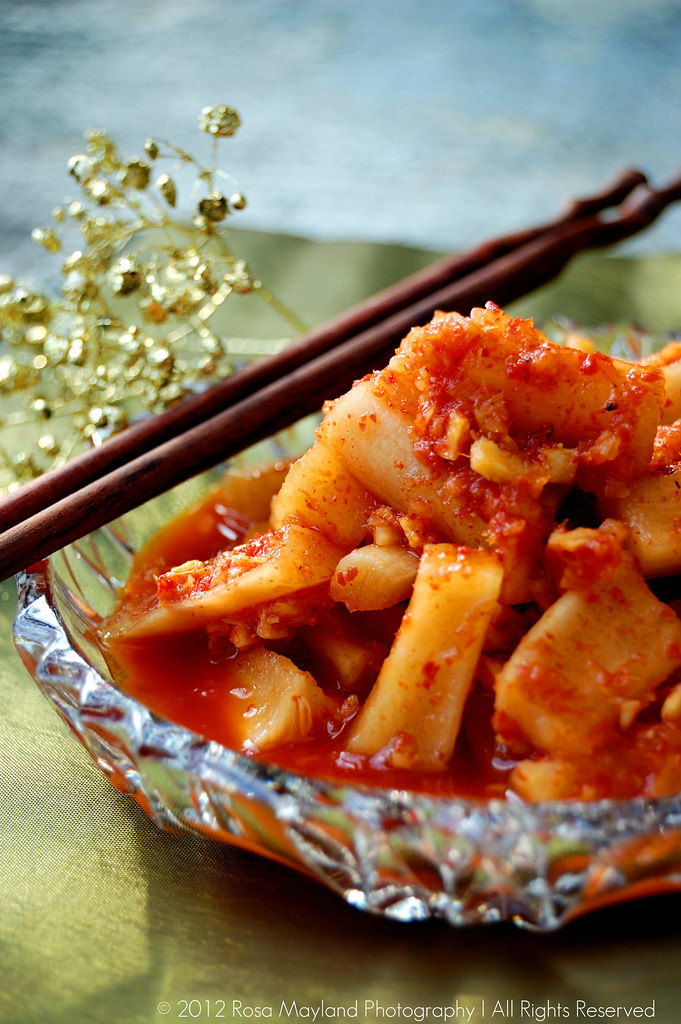
The standard method is applied to the recipe, however serveral elements of the marinade are not conform to The land Of The Morning Calm's standards. "Kochukaru" is replaced by Turkish chilli flakes and paprika powder and the salted shrimps ("Saewoo Jjut") by Thai shrimp paste, nonetheless, it is just like the true stuff.
My "Daikon Kimchi" is intensely aromatic and pungent, exhaliratingly gingery, powerfully garlicky, soothingly sweet, slightly fishy, mildly hot and the fresh radish crunches delightfully under the teeth. This is definitely the ultimate accompaniment to eggs, grilled meat or fish, potatoes, rice, noodles, soup or sandwich!
~ Daikon Kimchi ~
Recipe by Rosa Mayland, January 2012.
Makes about 2 cups kimchi.
Ingredients For The "Salting":
2 Cups Daikon (white raddish), peeled and cut into not too thin matchsticks or chunks
1/2 Tbs Sea salt
1 Tbs Castor sugar
Ingredients For The "Marinade":
3 Cloves Garlic, chopped
2 1/2 Tbs Ginger, chopped
1/8 Cup Kirmizi biber
1 Tbs Sweet Paprika
1/3 Tsp Shrimp paste
1/8 Cup + 1 Tsp Castor sugar
1/8 Cup Fish sauce
1 1/2 Tbs Sweet soy sauce
Method For The "Salting":
1. In a bowl, toss the chunks of daikon with the salt and sugar.
2. Let sit for about 2 hours.
3. Drain well.

Method For The "Marinade":
4. In a mortar, crush the garlic, ginger, chilli flakes, paprika, shrimp paste together with the sugar until you obtain a thickish paste.
5. Add this paste, the fish sauce and the soy sauce to the drained daikon. Mix well.
6. Fill an airtight container with the kimchi and place in a brown paper sack (or otherwise shield from light) and let it stand/ferment at room temperature for 30 hours.
7. Serve right away or refrigerate.
7. Serve right away or refrigerate.
Remarks:
Normally, Koreans make their kimchi with the kochukaru (sweet chilli powder), but as I had none at hand, I decided to replace it with the Kirmizi Biber (sweet chilli flakes from Turkey). You can also use Espelette pepper if you wish.
Your kimchi will keep for up to 4 weeks in the refrigerator and will become stronger/better over time.
Serving suggestions:
Make "Bokkeumbap" ("Kimchi Fried rice") wih your kimchi. You can also serve it with eggs (scrambled, poached or omelet), potatoes (cubed and fried, roasted, rosti, etc...) or stir-fried noodles.
~~~~~~~~~~~~~~~~~~~~~~

~ Kimchi De Radis Blanc ~
Recette par Rosa Mayland, Janvier 2012.
Pour environ 2 tasses de kimchi.
Ingrédients Pour Le "Salage":
2 Tasses de Daikon (1 gros radis blanc), pelé et coupé en allumettes pas trop fines (bouchées)
1/2 CS de Sel de mer
1 CS de Sucre cristallisé
Ingrédients Pour La "Marinade":
3 Gousses d'ail, hachées grossièrement
2 1/2 CS de Gingembre haché grossièrement
30g (1/8 de Tasse) de Kirmizi Biber
1 CS de Paprika doux
1/3 de CC de Pâte de crevettes
30g (1/8 Tasse) + 1 CC de Sucre cristallisé
30ml (1/8 de Tasse) de Sauce de poisson
1 1/2 CS de Sauce soja légère (Kikkoman)
Ingrédients Pour Le "Salage":
2 Tasses de Daikon (1 gros radis blanc), pelé et coupé en allumettes pas trop fines (bouchées)
1/2 CS de Sel de mer
1 CS de Sucre cristallisé
Ingrédients Pour La "Marinade":
3 Gousses d'ail, hachées grossièrement
2 1/2 CS de Gingembre haché grossièrement
30g (1/8 de Tasse) de Kirmizi Biber
1 CS de Paprika doux
1/3 de CC de Pâte de crevettes
30g (1/8 Tasse) + 1 CC de Sucre cristallisé
30ml (1/8 de Tasse) de Sauce de poisson
1 1/2 CS de Sauce soja légère (Kikkoman)
Méthode Pour La "Salage":
1. Dans un bol, mélanger le daikon avec le sel et le sucre.
2. Laisser reposer pendant environ 2 heures.
3. Bien égoutter.

Méthode Pour La "Marinade":
4. Dans un mortier, piler l'ail, le gingembre, le piment, le paprika, la pâte de crevettes avec le sucre jusqu'à obtention d'une pâte assez épaisse.
5. Ajouter cette pâte ainsi que la sauce de poisson et la sauce soja au daikon égoutté. Bien mélanger.
6. Mettre dans un contenant herméthique et le placer dans un sac en papier brun (ou autrement à l'abri de la lumière) et laisser reposer/fermenter à température ambiante pendant 30 heures.
7. Servir immédiatement ou réfrigérer.
Remarques:
Normalement, les corréens fabrique leur kimchi avec du kochukaru (poudre de piment doux). Comme je n'en avait pas sous la main, j'ai décidé de la remplacer par son équivalent turc, le kirmizi biber (flocons de piment doux). On peut aussi utiliser du piment d'Espelette.
Le kimchi se conserve jusqu'à 4 semaines au réfrigérateur et sont goût s'améliore au fil du temps.
Idées de présentation:
C'est très sympa de cuisiner un "Bokkeubap" (riz frits au kimchi) avec votre kimchi de radis blanc ou bien de le servir avec des oeufs (pochés, frits, brouillés, omelette) et des pommes de terres (coupées en cubes et grillées, au four, röstis, etc...).
Remarques:
Normalement, les corréens fabrique leur kimchi avec du kochukaru (poudre de piment doux). Comme je n'en avait pas sous la main, j'ai décidé de la remplacer par son équivalent turc, le kirmizi biber (flocons de piment doux). On peut aussi utiliser du piment d'Espelette.
Le kimchi se conserve jusqu'à 4 semaines au réfrigérateur et sont goût s'améliore au fil du temps.
Idées de présentation:
C'est très sympa de cuisiner un "Bokkeubap" (riz frits au kimchi) avec votre kimchi de radis blanc ou bien de le servir avec des oeufs (pochés, frits, brouillés, omelette) et des pommes de terres (coupées en cubes et grillées, au four, röstis, etc...).